Thursday, 6 August 2015
Sticking to the Rules
I hope that whatever happened with the Kids Company is properly investigated. It certainly looks like politicians over riding legitimate financial checks as a result of favouritism. If so, I hope the relevant ministers get due punishment. It should also be a reminder of how important these kind of rules are. I often get the impression that some groups think that if they call themselves "community" or "volunteer" somehow financial rules shouldn't apply.

Wednesday, 5 August 2015
Shared Surface Around Willesden Library Centre
I have argued before that the area around Wembley Library is actually capable of being used for complementary activities in what is effectively a kind of co-location. I have similar hopes of the areas currently being paved at the back and on the Grange Road side of Willesden Library. Hopefully, this will assuage the concerns of those who supported the Town Green application.
The Grange Road side looks closer to completion, although it is still being paved:

The area should accommodate some disabled parking, but it is also (like part of Harlesden Town Centre) is a shared surface scheme so that the kerb level is quite limited.

A similar flexibility will be possible in the area at the back. Once the Cafe is let (which be located at the back on the Brondesbury Park side), I imagine it will will want to use that area for outside paving.

Incidentally, the cafe is obliged by its procurement criteria to sell Fairtrade goods. I hope that they will be publicized better than in the equivalent cafe in Wembley Library.
The Grange Road side looks closer to completion, although it is still being paved:

The area should accommodate some disabled parking, but it is also (like part of Harlesden Town Centre) is a shared surface scheme so that the kerb level is quite limited.

A similar flexibility will be possible in the area at the back. Once the Cafe is let (which be located at the back on the Brondesbury Park side), I imagine it will will want to use that area for outside paving.

Incidentally, the cafe is obliged by its procurement criteria to sell Fairtrade goods. I hope that they will be publicized better than in the equivalent cafe in Wembley Library.
Tuesday, 4 August 2015
Willesden Library Learning from Brent Civic Centre
The new Willesden Library Centre is now up and running, although it is still just the Library and the rebuilt Brent Museum with a lot of building work continuing in the surroundings (see below). This is not so different from the early period of Wembley Library which has subsequently become such a great success. A period of snagging on big projects such as these is inevitable.

I am glad to see that lessons seem to have been learnt from the early stages of the Civic Centre, with both water dispensers and signage installed from the beginning this time. The example below is from the lift. Nonetheless, I think a bit more will have to emerge. For example, the customer service bit is far from obvious as you come in. A friend of mine went all the way to the top and down again before finding it on the ground floor.

Many of the lessons from the Civic Centre seem quite slight. For example, the early stages of Brent Civic Centre problems with light carpets being soiled. The carpets in Willesden Library Centre are much darker, and I gather they are carpet tiles rather than carpets, which means that darkly stained areas can be more easily removed. Similarly I understand that the chairs are easier to clean.
That might seem quite trivial, but it can make a big difference to library users.

I am glad to see that lessons seem to have been learnt from the early stages of the Civic Centre, with both water dispensers and signage installed from the beginning this time. The example below is from the lift. Nonetheless, I think a bit more will have to emerge. For example, the customer service bit is far from obvious as you come in. A friend of mine went all the way to the top and down again before finding it on the ground floor.

Many of the lessons from the Civic Centre seem quite slight. For example, the early stages of Brent Civic Centre problems with light carpets being soiled. The carpets in Willesden Library Centre are much darker, and I gather they are carpet tiles rather than carpets, which means that darkly stained areas can be more easily removed. Similarly I understand that the chairs are easier to clean.
That might seem quite trivial, but it can make a big difference to library users.
Monday, 3 August 2015
Brent Council's Ongoing Employment Issues
Martin Francis' blog Wembley Matters, whilst often unfairly negative about Brent Council and openly politically partisan, has done a good service in highlighting concerns about certain employment practices in the Council. These have largely centred on the Rosemarie Clark case.
His most recent posts highlight an extremely unusual semi-public statement by Cllr Butt on the issue.
In fact, he kind of problems that have been a concern to me since 2012, and in my view go well beyond the individuals concerned and damage the whole organisation. It would be much less worrying if the Clarke case were indeed the only instance, but it is not. I have mentioned these problems a number of times. I think it is unlikely that the Council will be able to "move forward" as he puts it until these matters have been credibly and publicly investigated.
His most recent posts highlight an extremely unusual semi-public statement by Cllr Butt on the issue.
In fact, he kind of problems that have been a concern to me since 2012, and in my view go well beyond the individuals concerned and damage the whole organisation. It would be much less worrying if the Clarke case were indeed the only instance, but it is not. I have mentioned these problems a number of times. I think it is unlikely that the Council will be able to "move forward" as he puts it until these matters have been credibly and publicly investigated.
Sunday, 2 August 2015
Registering to Vote in Brent
Letters are already going out in Brent to register to vote. This is especially important as the register for this year will be used as the baseline for drawing up constituency boundaries. More information about registering is to be found here.
Saturday, 1 August 2015
WLWA Progresses Energy from Waste Plant
West London Waste Authority (WLWA) committed to diverting virtually all its waste from landfill back in 2013. Instead the waste will go to an Energy from waste plant in the West of England. It recently released an update. This will be an even more dramatic change across the whole of waste management in West London, than the introduction of Alternate Weekly Collections which is now being imitated by Ealing.
Friday, 31 July 2015
Martin Francis on the Former Preston Library
Martin Francis reports that the former Preston Library is going to be used for school places again. This means that the group using it under temporary license will have to move out. What I find odd about this is that the many problems of the Council just handing the building over to a group have been in the public domain for some time. In particular, the notion of a peppercorn rent seems wholly unrealistic.
As an addendum, I see that the group gives a precise figure for usage in June, 663. Measuring performance at volunteer libraries seems essential to me, and I regret that it is not done more often. In public libraries, June tends to be an unusually good month, but if we assume that for the Preston establishment it is average that would give an annualised footfall of 7,956. That might seem like a lot, but it demonstrates that a public library service such as Brent Libraries is operating on a totally different scale to the volunteer libraries that are sometimes suggested as their replacement.
In 2014/15, the Brent library with the lowest footfall was Kingsbury, which had a footfall of 146,870, or 12,239 in an average month. Brent's other libraries averaged much higher levels. When people such as Ed Vaizey advocate volunteer libraries they really are suggesting replacing the public library service with something fundamentally different.
As an addendum, I see that the group gives a precise figure for usage in June, 663. Measuring performance at volunteer libraries seems essential to me, and I regret that it is not done more often. In public libraries, June tends to be an unusually good month, but if we assume that for the Preston establishment it is average that would give an annualised footfall of 7,956. That might seem like a lot, but it demonstrates that a public library service such as Brent Libraries is operating on a totally different scale to the volunteer libraries that are sometimes suggested as their replacement.
In 2014/15, the Brent library with the lowest footfall was Kingsbury, which had a footfall of 146,870, or 12,239 in an average month. Brent's other libraries averaged much higher levels. When people such as Ed Vaizey advocate volunteer libraries they really are suggesting replacing the public library service with something fundamentally different.
Thursday, 30 July 2015
Library Opening Hours in Brent
I remarked in my post on the opening of Willesden Library that it has different opening hours to what became standard as part of the Libraries Transformation Project. Brent Libraries are due for another review, although I doubt whether it will be as far reaching as the 2011 one. It would be interesting to see the data as to whether a 9am opening is preferable to (say) the equivalent time in the evening. I have also heard people argue that Sunday opening would be welcome. Willesden Library is the only Brent library to open on Sunday mornings as opposed to Sunday afternoons, so it will be interesting to see how popular that is. Incidentally, I wonder how many Council libraries in the UK still open on Sundays at all?
Tuesday, 28 July 2015
Inside the New Willesden Library Centre

The new Willesden Library opened yesterday, and I must say it is even more spectacular than I imagined. As you can see from my previous post, the exterior still has builders all round it, who will continue working on the housing that pays for the whole project for quite a while to come, but the inside is now functioning as a library.
The library is on three floors with a central light well in the middle. The light looks like this from the ground floor:

The ground floor is too big for a single picture. Here is the part nearest Brondesbury Park:

Unlike the old Willesden Library, you can actually see out on to the street:

Looking more towards the back, you can see some of the ipads laid out:

When the builders finally depart, it will be possible to access the library from the rear as well as the front:

Now let's move up the stairs to the first floor:

The first floor is huge:

It has displays around the light well drawing on local history. I suspect these are intended to draw you up to the new Brent Museum on the second floor.

The second floor has yet more books, and yet more computers. This how it looks at the back. The windows face towards the housing.

As I was going round, one of the library staff started chatted to me. She said that rebuilding the library had been the subject of some controversy, a fact of which I was aware. I defy anyone who can remember the old Willesden Library Centre to say that the new one is not a huge improvement. I shall probably do some more posts in a while, particularly on the new Museum and the exhibition spaces that have yet to open. At the moment, I will just leave one last view of the light well:

Friday, 24 July 2015
What will be in the New Willesden Library Centre?
The new Willesden Library Centre opens on Monday morning. Full details of the services available are here.
Willesden Library Itself
Unlike other Brent libraries, Willesden is promised to open from 9am on week days (the rest open from 10am). Closing time on each weekday is 8pm, which again gives it longer opening hours than most Brent libraries, which only open that time for two or three days a week. Weekend opening is also slightly longer, with Willesden starting at 10am on Sundays, unlike Brent's other libraries which all open from noon on Sundays.
I assume that these opening hours are ones where the library is fully staffed i.e. not the situation where only self service is available in Wembley Library from 8am to 10am. Whilst that is welcome, it is obviously not as good as having properly staffed opening hours.
We are promised that the library will also feature:
The new library centre will also host Brent Museum and archives as well as a gallery space with a number of exhibitions planned for the Summer. The building will have a number of other spaces available for hire. Unlike the old building, these have been designed to be suitable for performances (The old Willesden Centre spaces had such poor sound insulation that neighbours would complain). The library also has a cafe, which is one of the features that makes Wembley Library such a success. Finally, there are a number of self service kiosks for accessing Council services.
That is all an enormous step forward which only came about because we pursued the Libraries Transformation Project to a conclusion, and overcame the often spurious objections to the development.
Willesden Library Itself
Unlike other Brent libraries, Willesden is promised to open from 9am on week days (the rest open from 10am). Closing time on each weekday is 8pm, which again gives it longer opening hours than most Brent libraries, which only open that time for two or three days a week. Weekend opening is also slightly longer, with Willesden starting at 10am on Sundays, unlike Brent's other libraries which all open from noon on Sundays.
I assume that these opening hours are ones where the library is fully staffed i.e. not the situation where only self service is available in Wembley Library from 8am to 10am. Whilst that is welcome, it is obviously not as good as having properly staffed opening hours.
We are promised that the library will also feature:
- the latest fiction, non-fiction and information for adults and children
- comfortable furnishings
- loan and reference books for adults and children in many languages including Tamil, Gujurati, Polish, Arabic, Urdu, French, Spanish and Portuguese
- a spacious area for children and parents with books and reading space
- 66 public computers
- colour photocopier, printer and scanner
- 14 iPads
- over 120 study spaces in the main library
- teen area
- IT facilities and Wi-Fi
- free online resources such as E-book downloads, E-magazines and learning courses
- DVDs
- audio books
- newspapers and magazines
- A series of public events of diverse kinds.
The new library centre will also host Brent Museum and archives as well as a gallery space with a number of exhibitions planned for the Summer. The building will have a number of other spaces available for hire. Unlike the old building, these have been designed to be suitable for performances (The old Willesden Centre spaces had such poor sound insulation that neighbours would complain). The library also has a cafe, which is one of the features that makes Wembley Library such a success. Finally, there are a number of self service kiosks for accessing Council services.
That is all an enormous step forward which only came about because we pursued the Libraries Transformation Project to a conclusion, and overcame the often spurious objections to the development.
Monday, 20 July 2015
New Willesden Green Library Pictures
The new Willesden Green Library is opening on 27 July, as the last stage of the Libraries Transformation Project begun back in 2011. I gather that copies of Go Set a Watchman have been ordered specially for the opening day. The new library will have a capacity of around 40,000 books, which is even more than the refurbished Kilburn Library.
I have mentioned before that the old Willesden Library had a terrible relationship with the surrounding area. The new area is still a building site, but looks much better in terms of interacting with its surroundings.

This is the remains of the former 1890s library that used to be on the site. Actually, most of the building was reconstructed when the 1890s library was mostly demolished in the 1980s, so it ac6tually fairly modern. Some think that keeping this 1890s style extension on to a modern building looks a bit odd, but there was undoubtedly great public demand for it to remain.

This is some of the new housing that pays for the new cultural centre. It is seen from the Brondesbury Park side.

This is what some of the anti-library people described as the "canyon" between the new library centre (to the left) and the new housing to the right. I think, that once all the building stuff is cleared away, it could be a nice public space.

This is a better view of the new housing as it looks on to the back of the library centre.

This is a view of the new library centre from the Grange Road side looking towards Willesden High Road.

This is a full on view of the Grange Road side taken from the interim library in George Furness House showing more the detailing. The 1980s library centre simply had a blank featureless wall here, which was visually so dull that I have been unable to find any photo of it for contrast.
Although it is still a bit difficult to visualise it at the moment because of all the builder's stuff still around, I think the new building should look really good.
I have mentioned before that the old Willesden Library had a terrible relationship with the surrounding area. The new area is still a building site, but looks much better in terms of interacting with its surroundings.

This is the remains of the former 1890s library that used to be on the site. Actually, most of the building was reconstructed when the 1890s library was mostly demolished in the 1980s, so it ac6tually fairly modern. Some think that keeping this 1890s style extension on to a modern building looks a bit odd, but there was undoubtedly great public demand for it to remain.

This is some of the new housing that pays for the new cultural centre. It is seen from the Brondesbury Park side.

This is what some of the anti-library people described as the "canyon" between the new library centre (to the left) and the new housing to the right. I think, that once all the building stuff is cleared away, it could be a nice public space.

This is a better view of the new housing as it looks on to the back of the library centre.

This is a view of the new library centre from the Grange Road side looking towards Willesden High Road.

This is a full on view of the Grange Road side taken from the interim library in George Furness House showing more the detailing. The 1980s library centre simply had a blank featureless wall here, which was visually so dull that I have been unable to find any photo of it for contrast.
Although it is still a bit difficult to visualise it at the moment because of all the builder's stuff still around, I think the new building should look really good.
Tuesday, 14 July 2015
Mahatma Gandhi House in Wembley
I see Mahatma Gandhi House has been sold for housing. Unfortunately, Brent Council will not get a capital receipt, as it was only renting there. Still, it may allow the Council to save some money, as it was locked into a lease there which continued after the Council moved to the Civic Centre.
Monday, 13 July 2015
Brent Council Library Closures
Public Libraries News has a rather gloomy prognosis that Council's that have already gone through a round of library cuts will soon see another. For many this is true. He cites the Isle of Wight and North Yorkshire, but there will be others coming up.
I doubt, however, whether we will see any actual closures in Brent (indeed Brent is just about to open the new library in Willesden).
Although there is a new library strategy due to come forward for consultation soon, I would be very surprised if any closures result. I know that library closures were put forward as an option in the last two years, but it was a paper option, which no one really considered seriously. Indeed one of the unintended benefits of the furore surrounding the 2011 library proposals is that there is likely to be little enthusiasm for another round.
More subtly, the litigation in 2011/2012, also gives the Council a firmly defensible baseline. The library needs of the Borough were assessed, according to the judge, "with rigour" and upheld as sensible. The same settlement was put to the Secretary of State for overturning, only for the request to be rejected. Of course, Brent Libraries can also now demonstrate a remarkable record of success under the same project.
The danger now is not so much one of closures as the kind of hollowing out that I sought to avoid in 2011. We have seen bits and pieces of this in Brent, most notably the cut in the book fund in this year's budget. However, so far Brent libraries have retained crucial aspects like seven day opening. The danger is that hours and other things will be reduced little by little in a way that attracts little publicity, but has a huge effect on the service.
I doubt, however, whether we will see any actual closures in Brent (indeed Brent is just about to open the new library in Willesden).
Although there is a new library strategy due to come forward for consultation soon, I would be very surprised if any closures result. I know that library closures were put forward as an option in the last two years, but it was a paper option, which no one really considered seriously. Indeed one of the unintended benefits of the furore surrounding the 2011 library proposals is that there is likely to be little enthusiasm for another round.
More subtly, the litigation in 2011/2012, also gives the Council a firmly defensible baseline. The library needs of the Borough were assessed, according to the judge, "with rigour" and upheld as sensible. The same settlement was put to the Secretary of State for overturning, only for the request to be rejected. Of course, Brent Libraries can also now demonstrate a remarkable record of success under the same project.
The danger now is not so much one of closures as the kind of hollowing out that I sought to avoid in 2011. We have seen bits and pieces of this in Brent, most notably the cut in the book fund in this year's budget. However, so far Brent libraries have retained crucial aspects like seven day opening. The danger is that hours and other things will be reduced little by little in a way that attracts little publicity, but has a huge effect on the service.
Sunday, 12 July 2015
Willesden Green Library Opening
The opening of Willesden Green's new library, the last stage in Brent Council's Libraries Transformation Project, is due on 27 July. This means that the interim service will close on 23 July. I hope the new library will be as great a success as its counterpart in Wembley.
Friday, 3 July 2015
Kilburn Calling
Cllr John Duffy has started a blog on Kilburn and Brent Council matters. I imagine it will be interesting as he develops it. He makes one accusation which is quite worrying.
He suggests that some one at Brent Council is snooping on Councillor emails. He doesn't actually prove this in his blogpost. As I read it, Council officers could have become aware of his correspondence once residents contacted him, but if he is correct, Council officers are operating unethically and possibly illegally.
This is because, as a councillor, John almost certainly has to deal with confidential information belonging to his constituents. For example, pursuing a housing case might well involve medical or financial details that the constituent can expect to keep private. It would be reasonable for Cllr Duffy to quote such information to housing officers dealing with the case, but if a member of Brent's IT department were accessing it that strikes me as a breach of confidentiality, and therefore of data protection laws. I am not sure what the Law says more generally about snooping, but I suspect that John would have a case that his emails can't just be randomly trawled through.
The former, and for all I know, current policy of Brent Council on such matters is that electronic communications can only be monitored if there is "reasonable suspicion" that they are being misused in this way. I recall this from discussing it with the Borough Solicitor, who was the senior officer responsible at the time.
Nor is this an abstract issue. It came up when former Cllr Dhiraj Kataria made false allegations against a colleague, that had to be examined in a lengthy report by a solicitor. Part of that case (dealt with 3.17 of the Brent Council covering report) referred to an email sent on 23 December to Cllr Paul Lorber. Cllr Kataria denied sending it and cast aspersions on various colleagues, but these was discovered to be untrue once a technical investigation was ordered. However, this was only done on 28 March 2012, after Cllr Paul Lorber had failed to answer the question about who had sent the email to him. The passage in the Solicitor's report dealing with this issue (4.147-4.152) mentions Human Rights protection in a gfeneral way, without going into detail.
I think that if John really believes that his emails are or have been intercepted, he should ask Brent's new Chief Executive to order an investigation, and whoever has been intercepting the communications should be subject to disciplinary action.
He suggests that some one at Brent Council is snooping on Councillor emails. He doesn't actually prove this in his blogpost. As I read it, Council officers could have become aware of his correspondence once residents contacted him, but if he is correct, Council officers are operating unethically and possibly illegally.
This is because, as a councillor, John almost certainly has to deal with confidential information belonging to his constituents. For example, pursuing a housing case might well involve medical or financial details that the constituent can expect to keep private. It would be reasonable for Cllr Duffy to quote such information to housing officers dealing with the case, but if a member of Brent's IT department were accessing it that strikes me as a breach of confidentiality, and therefore of data protection laws. I am not sure what the Law says more generally about snooping, but I suspect that John would have a case that his emails can't just be randomly trawled through.
The former, and for all I know, current policy of Brent Council on such matters is that electronic communications can only be monitored if there is "reasonable suspicion" that they are being misused in this way. I recall this from discussing it with the Borough Solicitor, who was the senior officer responsible at the time.
Nor is this an abstract issue. It came up when former Cllr Dhiraj Kataria made false allegations against a colleague, that had to be examined in a lengthy report by a solicitor. Part of that case (dealt with 3.17 of the Brent Council covering report) referred to an email sent on 23 December to Cllr Paul Lorber. Cllr Kataria denied sending it and cast aspersions on various colleagues, but these was discovered to be untrue once a technical investigation was ordered. However, this was only done on 28 March 2012, after Cllr Paul Lorber had failed to answer the question about who had sent the email to him. The passage in the Solicitor's report dealing with this issue (4.147-4.152) mentions Human Rights protection in a gfeneral way, without going into detail.
I think that if John really believes that his emails are or have been intercepted, he should ask Brent's new Chief Executive to order an investigation, and whoever has been intercepting the communications should be subject to disciplinary action.
Tuesday, 30 June 2015
Brent Musuem in Willesden Opening Soon
When the Brent Museum re-opens in Willesden this Summer, we are promised an exhibition on Britain's relationship with Gujarat. This is partly funded by Arts Council England, and follows on from other successful exhibitions in Brent in the past. Having the Museum co-located with the new library helps attract visitors to both.
Thursday, 25 June 2015
Brent Libraries Under Ambitious?
I have been looking at Brent's Corporate Plan for 2015 to 2016. My general experience of such documents is that they are not massively useful unless the people writing them really think it through. However the library targets are worth commenting on. They are:
"an increase in library visits to 2,205,179 visits a year"
and
"an increase in issues to 1,124,383 a year."
The first surprise is the precision of those figures, which I assume have been generated by some mechanistic formula.
The second is the low ambition, compared to the most recent completed year figures. 2,205,179 visits is scarcely up form the 2014/15 figure of 2,112,149. Unless the new Willesden Library is a disaster (which I am sure it will not be) that is amazingly modest growth. The issue figures also seem low, although given difficulties with increasing issues in the past, that caution is more understandable.
Is something going to happen in Brent Libraries to overturn the success of the last few years?
"an increase in library visits to 2,205,179 visits a year"
and
"an increase in issues to 1,124,383 a year."
The first surprise is the precision of those figures, which I assume have been generated by some mechanistic formula.
The second is the low ambition, compared to the most recent completed year figures. 2,205,179 visits is scarcely up form the 2014/15 figure of 2,112,149. Unless the new Willesden Library is a disaster (which I am sure it will not be) that is amazingly modest growth. The issue figures also seem low, although given difficulties with increasing issues in the past, that caution is more understandable.
Is something going to happen in Brent Libraries to overturn the success of the last few years?
.
Wednesday, 24 June 2015
Air Quality Action Plan?
I notice that Brent Council's corporate plan has an aim of agreeing a successor Air Quality Management Plan by June 2015. I wonder when it is going to happen, and what will be in it?
Tuesday, 23 June 2015
School Places in Wembley
I see that the next Brent Cabinet, is making emergency provision to have temporary school places at Elsley Primary School in Wembley. Of course, the rise in school places is a problem afflicting most London authorities. However, it does seem odd that Brent Council have recently emptied temporary classes in the former Preston Library, also in the Wembley area, whilst rushing through an expensive conversion of school premises fairly close by.
Why not just use the classrooms that were already kitted out for primary school children in a building that the Council owns?
UPDATE
I now understand that the former Preston Library building is being used for pupils from Wembley High.
Why not just use the classrooms that were already kitted out for primary school children in a building that the Council owns?
UPDATE
I now understand that the former Preston Library building is being used for pupils from Wembley High.
Monday, 22 June 2015
Gordon Brown Outdoor Education Centre
I see that the next Brent Cabinet is considering investing in refurbishing part of the Gordon Brown Outdoor Education Centre. The situation for Brent Youth services is not quite as bleak as it appeared at one time, but they are still likely to be cut back dramatically. The report points out the benefit that children gain from using the centre in outdoor activities and improving environmental awareness. It occurs to me that very similar arguments could be made for the Welsh Harp Environemental Education Centre, which has now been put out to tender.
Sunday, 21 June 2015
The Political Importance of Air Quality
John Vidal has a long piece on air quality in the Guardian. This seems to be getting more of a profile after years in which it was seen as a fairly minor issue. I recall raising it with some London Councils colleagues only for it to be seen as a fringe concern.
Brent actually has quite a reasonable record on improving air quality. There is, of course, the ongoing blight of poor air quality in Neasden Goods Yard. The trouble here is that the Environment Agency is extremely reluctant to take action. Boris Johnson until recently had no interest in air quality at all, and only seems to have woken up to the seriousness of the situation in the last few months.
Aside from that specific area, London Boroughs main contribution to better air quality is by reducing traffic pollution.
This was one aim behind the introduction of emissions based parking charges in Brent. Although most of the publicity behind this concentrated on carbon emissions, those are also a good proxy for other pollutants, such as PM2.5 and NOx.
Councils can also use planning policy to limit car use and encourage other forms of transport as Brent generally does. This is also the justification behind most of the Council's policies on parking charges.
However, I suspect progress on these issues is likely to be stymied by a reluctance of decision makers to accept that political decisions can have a good outcome in one direction but not in another. I get that sense from some of the comments in the Vidal piece. It also seems to happen locally here in Brent, where the Council has tinkered with parking charges in a way that seems to encourage car use at the same time as having other policies to discourage car use. That really doesn't make much sense.
Brent actually has quite a reasonable record on improving air quality. There is, of course, the ongoing blight of poor air quality in Neasden Goods Yard. The trouble here is that the Environment Agency is extremely reluctant to take action. Boris Johnson until recently had no interest in air quality at all, and only seems to have woken up to the seriousness of the situation in the last few months.
Aside from that specific area, London Boroughs main contribution to better air quality is by reducing traffic pollution.
This was one aim behind the introduction of emissions based parking charges in Brent. Although most of the publicity behind this concentrated on carbon emissions, those are also a good proxy for other pollutants, such as PM2.5 and NOx.
Councils can also use planning policy to limit car use and encourage other forms of transport as Brent generally does. This is also the justification behind most of the Council's policies on parking charges.
However, I suspect progress on these issues is likely to be stymied by a reluctance of decision makers to accept that political decisions can have a good outcome in one direction but not in another. I get that sense from some of the comments in the Vidal piece. It also seems to happen locally here in Brent, where the Council has tinkered with parking charges in a way that seems to encourage car use at the same time as having other policies to discourage car use. That really doesn't make much sense.
Saturday, 20 June 2015
Willesden Library Opening
I am glad to see that the new Willesden Green Library is scheduled to officially open on 27 July. This is the final stage in the Libraries Transformation Project, which has been so successful and overcome such formidable obstacles. As well as being a great success in itself, I hope the new Library centre can also boost the regeneration of Willesden High Road.
Friday, 19 June 2015
Legal Action on Libraries
Public Interest Lawyers are apparently gathering evidence prior to a legal action against the DCMS for not exercising its powers of supervision over libraries. I assume that this is largely as a result of their involvement in the Sheffield case. It will be interesting to see whether they get anywhere. In the Brent case both the SoS' reasoning and that of the High Court struck me as unarguable.
Thursday, 18 June 2015
Alternate Weekly Collections in Ealing
I see that Ealing Council is proposing to introduce Alternate Weekly Collections just as Brent did. The article cites Brent as having achieved a big recycling increase through precisely this technique as indeed Brent did.
Wednesday, 17 June 2015
Cutting Councillors
Apparently, the Local Government Commission for England is considering cutting the number of councillors in various northern cities. This isn't actually new. The last review in Brent (implemented in 2002) cut the number of Brent councillors from 66 to 63. However, the writer may well be right in suggesting that Whitehall is pushing an agenda around promoting directly elected mayors, despite their obvious unpopularity with the public.
Tuesday, 16 June 2015
Brent Appears in Private Eye Again
Brent has appeared in Private Eye again, although not to the detriment of the Authority this time. It comments on how Free Schools have found it difficult to find a site in the Borough. The exception is the Michaela School, which after being refused various sites in South London, ended up near Wembley Park. As Private Eye suggests, it looks as if the Michaela School was just put in Brent, because nowhere else was available. There appears to have been no real consideration of local needs; just a determination that Tory crony Birbalsingh be given something.
Monday, 15 June 2015
Corrib Rest Queens Park
The Corrib Rest on Salusbury Road is closed, and a number of residents are seeking to prevent its redevelopment by listing it as an asset of community value (ACV). Unfortunately ACV status does not do what many people seem to think it does.
Planning
An idea has gone around that ACV status is important in refusing planning permission. This emerged as widely held belief as part of the campaign against rebuilding The Queensbury in Willesden. In fact, the Planning Inspector gave no real consideration to ACV status in that case. Whereas ACV status is a "material consideration" that just means that the Committee consider it, it carries no particular guidance as to how much weight they attach. In both The Queensbury and the former Kensal Rise Library cases, officers advised that ACV status was not an important factor.
What can be more important is change of use from "community use" (D1) status. Brent has a policy of resisting loss of community space (defined as D1 class in planning terms), so that can be a barrier to redevelopment. It certainly was in the Kensal Rise case, as library use is unequivocally D1 status. It also featured in The Queensbury, as it was argued that some of the pub uses were effectively community use (especially the Busy Rascals toddler group). However, the developer met those concerns in the proposal so it was not a reason for refusal, and therefore never came before the Inspector.
I am not sure whether parts of the Corrib Rest might have a claim to D1 status, given its former somewhat controversial history as the Irish Centre. It may do as it might be viewed as a community centre, and it might be possible to retrospectively classify it as such, although I am sure that any developer would challenge such a move. If it is simply seen as a pub such a move would not be possible and it would not have protection against change of use.
Pub Protection
In some authorities, pubs do have specific protection, but not in Brent. I understand The Queensbury campaign lobbied for such a policy, and were even promised changes would be made to the Council's Planning policies, but no such changes were made at the relevant meetings.
ACV Status and Ownership Transfer
Where ACV status might be relevant to any Corrib Rest development is in terms of transfer of ownership. This is in fact the main purpose of ACV status under the Localism Act. If successfully listed, ACV listing would force a moratorium on any sale for six months to allow community groups to see if they could muster sufficient funds to buy the property.
Again this is not as much of a barrier as it sounds. With London prices, I doubt whether any community group could afford anything like the market price. The owner does not actually have to sell to such a group in any case, merely allow a six month pause. Ownership has no effect on planning permission. I have heard a rumour that people are being told that the Council can delay considering a planning application because of ACV status. I am sure that is wrong. The Council is obliged to consider all applications (including any that came from some one who did not own the land). If it were to refuse to do so, or delay without good reason, the applicant could appeal to the Planning Inspector and get a decision that way.
A final point worth making, is that ACV status only kicks in if the Council actually decides to grant it, which is not automatic. If the building were to be sold prior to ACV status being granted, there would be no moratorium, as happened in the case of the former Kensal Rise Library.
UPDATE
One of the comments below points out that ACV status will automatically force an applicant to ask for planning permission if they want to change the Corrib Rest from a pub to something else, following changes to the use class rules that came into force from April. I still suspect that this something of a distraction, however, as Brent has historically given little weight to ACV status as a planning consideration.
FURTHER UPDATE
It is odd how irate anonymous comments can be. In response to the most recent comment, I have published a correction. As far as I am aware, no one currently knows if there is any plan to change the use of the Corrib Rest. There may be, or it might reopen as a pub/restaurant again as has often happened in other cases.
Planning
An idea has gone around that ACV status is important in refusing planning permission. This emerged as widely held belief as part of the campaign against rebuilding The Queensbury in Willesden. In fact, the Planning Inspector gave no real consideration to ACV status in that case. Whereas ACV status is a "material consideration" that just means that the Committee consider it, it carries no particular guidance as to how much weight they attach. In both The Queensbury and the former Kensal Rise Library cases, officers advised that ACV status was not an important factor.
What can be more important is change of use from "community use" (D1) status. Brent has a policy of resisting loss of community space (defined as D1 class in planning terms), so that can be a barrier to redevelopment. It certainly was in the Kensal Rise case, as library use is unequivocally D1 status. It also featured in The Queensbury, as it was argued that some of the pub uses were effectively community use (especially the Busy Rascals toddler group). However, the developer met those concerns in the proposal so it was not a reason for refusal, and therefore never came before the Inspector.
I am not sure whether parts of the Corrib Rest might have a claim to D1 status, given its former somewhat controversial history as the Irish Centre. It may do as it might be viewed as a community centre, and it might be possible to retrospectively classify it as such, although I am sure that any developer would challenge such a move. If it is simply seen as a pub such a move would not be possible and it would not have protection against change of use.
Pub Protection
In some authorities, pubs do have specific protection, but not in Brent. I understand The Queensbury campaign lobbied for such a policy, and were even promised changes would be made to the Council's Planning policies, but no such changes were made at the relevant meetings.
ACV Status and Ownership Transfer
Where ACV status might be relevant to any Corrib Rest development is in terms of transfer of ownership. This is in fact the main purpose of ACV status under the Localism Act. If successfully listed, ACV listing would force a moratorium on any sale for six months to allow community groups to see if they could muster sufficient funds to buy the property.
Again this is not as much of a barrier as it sounds. With London prices, I doubt whether any community group could afford anything like the market price. The owner does not actually have to sell to such a group in any case, merely allow a six month pause. Ownership has no effect on planning permission. I have heard a rumour that people are being told that the Council can delay considering a planning application because of ACV status. I am sure that is wrong. The Council is obliged to consider all applications (including any that came from some one who did not own the land). If it were to refuse to do so, or delay without good reason, the applicant could appeal to the Planning Inspector and get a decision that way.
A final point worth making, is that ACV status only kicks in if the Council actually decides to grant it, which is not automatic. If the building were to be sold prior to ACV status being granted, there would be no moratorium, as happened in the case of the former Kensal Rise Library.
UPDATE
One of the comments below points out that ACV status will automatically force an applicant to ask for planning permission if they want to change the Corrib Rest from a pub to something else, following changes to the use class rules that came into force from April. I still suspect that this something of a distraction, however, as Brent has historically given little weight to ACV status as a planning consideration.
FURTHER UPDATE
It is odd how irate anonymous comments can be. In response to the most recent comment, I have published a correction. As far as I am aware, no one currently knows if there is any plan to change the use of the Corrib Rest. There may be, or it might reopen as a pub/restaurant again as has often happened in other cases.
Sunday, 14 June 2015
Congratulations Cllr Lesley Jones
Congratulations are due to Cllr Lesley Jones who has been awarded a MBE. Cllr Lesley Jones represents Willesden Green and is also this year's Mayor for Brent.
Sunday, 7 June 2015
Harrow Libraries Debate
I see that Bob Blackman MP is doing some grandstanding on libraries in Harrow. He has apparently also called for a Westminster Hall Debate on Tuesday. This all sounds like an effort to distract from the fact that his government is imposing huge cuts on local authorities like Harrow. Any vote in Westminster Hall will in any case have no effect on Harrow's library policy. I suspect the article's reference to a review by Ed Vaizey will actually turn out to be considering whether to review.
Incidentally, I don't recall Bob Blackman once mentioning libraries in his time as a Brent Councillor.
Incidentally, I don't recall Bob Blackman once mentioning libraries in his time as a Brent Councillor.
Thursday, 4 June 2015
Visits to Wembley Library
I mentioned that the extrordinary success of Brent Libraries is linked to the growth in Wembley Library numbers. It is worth seeing just how dramatic the improvement at Wembley has been in graphic form.

That growth in numbers probably puts Wembley Library in the country's top ten libraries. The first two years show the visit numbers for the Brent Town Hall library. The third column starts to show the effect of the new Wembley Library, which opened on 17 June 2013. It shows growth of more than 200% on the previous year. The final column shows the numbers for a full year of operation. It is fortunate that the efforts to stop or downgrade Wembley Library failed.
UPDATE
Once again, there is a comment suggesting that the methodology of counting users is wrong. I have dealt with this suggestion here. I have also dealt with the even more far out suggestion that the growth in numbers is all down to fire drills here. The methodology is defined by CIPFA and applies to all 151 library authorities in England. If you don't like it, you can ask CIPFA to change it. The point of having CIPFA using the same standard for all library services is so that meaningful comparisons can be made.
ANOTHER UPDATE
I think this is the last comment I am going to publish on this subject as the anonymous poster simply refuses to accept the facts. The CIPFA methodology applies to all library authorities, and Brent meets their criteria. That is just the way it is. There is nothing "dishonest" in that assertion. The simple fact is that Brent's Library Transformation Project was found to be entirely sound when examined in exhaustive detail by the High Court, and the subsequent satisfaction ratings and user & loan figures confirm its success.
That growth in numbers probably puts Wembley Library in the country's top ten libraries. The first two years show the visit numbers for the Brent Town Hall library. The third column starts to show the effect of the new Wembley Library, which opened on 17 June 2013. It shows growth of more than 200% on the previous year. The final column shows the numbers for a full year of operation. It is fortunate that the efforts to stop or downgrade Wembley Library failed.
UPDATE
Once again, there is a comment suggesting that the methodology of counting users is wrong. I have dealt with this suggestion here. I have also dealt with the even more far out suggestion that the growth in numbers is all down to fire drills here. The methodology is defined by CIPFA and applies to all 151 library authorities in England. If you don't like it, you can ask CIPFA to change it. The point of having CIPFA using the same standard for all library services is so that meaningful comparisons can be made.
ANOTHER UPDATE
I think this is the last comment I am going to publish on this subject as the anonymous poster simply refuses to accept the facts. The CIPFA methodology applies to all library authorities, and Brent meets their criteria. That is just the way it is. There is nothing "dishonest" in that assertion. The simple fact is that Brent's Library Transformation Project was found to be entirely sound when examined in exhaustive detail by the High Court, and the subsequent satisfaction ratings and user & loan figures confirm its success.
Monday, 1 June 2015
Bulky Item Collection in Brent and Hounslow
I see Hounslow are adopting a Brent style bulky items collection service, with a very similar reasoning. The introduction of charging for this service led to a steep decline in collections, and it is reasonable to assume that some of the items no longer collected for free get dumped on the streets. Brent should think about this in case it is again suggested that charging be re-introduced.
Thursday, 28 May 2015
Brent Library Cards in the Guardian
Brent Library Cards feature in this piece on library cards from the Guardian. I remember the delight on the face of the little girl who won the design competition for the library card, which was a delight to see.
Wednesday, 27 May 2015
Brent Council Confused Over Property
Perhaps the most interesting paper before Brent Council's next Cabinet is its new property strategy. This marks a radical reversal of previous policy, which was to dispose of property if it was not going to be used for public purposes.
The new strategy has two apparently contradictory aims. One is to maximise value through renting property. The second is maximise "social value" through renting below market rates to worthy causes. Of course this all takes place in an environment where the Council's income from fees & charges, Council Tax and government grant will all be in decline. Inevitably, this locks Brent Council into cutting public services to the maximum extent possible, which I suspect is not a policy that the majority of those who voted in May 2014 would support (although it is very much what the newly elected Tory government supports).
A still more startling suggestion is that:
" In particular there is scope to develop the investment portfolio within the residential market (where the highest growth potential exists) in order to both support endeavours to meet housing need and deliver a revenue return."
That5 sounds like the Council wanting to become its own property developer. The only recent example of the Council pursuing this role is in Thames Court in South Kilburn, where the Council had all sorts of cost overruns and quality problems. In short it was not a success. Hence the Council's subsequent reliance on private developers who know more about running building projects.
It also of course plunges the Council into the middle of the debate about affordable housing and planning gain. Developers seek to minimise affordable housing because they make more money that way. That would be in line with the Council's desire for a "revenue return". That is flatly contradictory to the other aim of using the policy to "meet housing need.
Another area of concern is the arbitrariness of decisions under this policy. We have seen before that such decisions can be based around the historical accident of where buildings happen to be, the actual of perceived strength of certain lobby groups, the closeness of such groups to particular figures on the Council, and not the rational interests or strategy of the Council. At its worst, such an approach can lead to the kind of politics that now appears to be coming to an end in Tower Hamlets.
I am also struck by the lack of realism in some of the wording about "buying" in large stretches of the Borough. With what precisely? The Council's own access to capital and revenue funding is being rapidly depleted by central government, and increasingly its own decisions. Other potential partners, such as housing associations, seem likely to have their resources cut by the Tory government's policies, most notably extending the Right to Buy. Where does Brent Council think it is going to get the money from?
Altogether, I get the impression of an institution that doesn't really have a clear idea of what its priorities are. It just has a vague idea it wants to be nice to everyone.
The new strategy has two apparently contradictory aims. One is to maximise value through renting property. The second is maximise "social value" through renting below market rates to worthy causes. Of course this all takes place in an environment where the Council's income from fees & charges, Council Tax and government grant will all be in decline. Inevitably, this locks Brent Council into cutting public services to the maximum extent possible, which I suspect is not a policy that the majority of those who voted in May 2014 would support (although it is very much what the newly elected Tory government supports).
A still more startling suggestion is that:
" In particular there is scope to develop the investment portfolio within the residential market (where the highest growth potential exists) in order to both support endeavours to meet housing need and deliver a revenue return."
That5 sounds like the Council wanting to become its own property developer. The only recent example of the Council pursuing this role is in Thames Court in South Kilburn, where the Council had all sorts of cost overruns and quality problems. In short it was not a success. Hence the Council's subsequent reliance on private developers who know more about running building projects.
It also of course plunges the Council into the middle of the debate about affordable housing and planning gain. Developers seek to minimise affordable housing because they make more money that way. That would be in line with the Council's desire for a "revenue return". That is flatly contradictory to the other aim of using the policy to "meet housing need.
Another area of concern is the arbitrariness of decisions under this policy. We have seen before that such decisions can be based around the historical accident of where buildings happen to be, the actual of perceived strength of certain lobby groups, the closeness of such groups to particular figures on the Council, and not the rational interests or strategy of the Council. At its worst, such an approach can lead to the kind of politics that now appears to be coming to an end in Tower Hamlets.
I am also struck by the lack of realism in some of the wording about "buying" in large stretches of the Borough. With what precisely? The Council's own access to capital and revenue funding is being rapidly depleted by central government, and increasingly its own decisions. Other potential partners, such as housing associations, seem likely to have their resources cut by the Tory government's policies, most notably extending the Right to Buy. Where does Brent Council think it is going to get the money from?
Altogether, I get the impression of an institution that doesn't really have a clear idea of what its priorities are. It just has a vague idea it wants to be nice to everyone.
Tuesday, 26 May 2015
Brent Council Fees and Charges
I note the forthcoming report on Brent Council's fees and charges is to tread water on most of them. This is different from the previous policy, which was to have a default of increasing them in line with inflation. It essentially locks Brent Council into a pattern of diminishing spending as the frozen fee levels see less and less revenue. Historically this has been periodically reversed with large above average increases to all income to "catch up".
The officers advise (at 4.4.in the report) that:
It is therefore rather similar to the arguments over freezing Council Tax levels that led to such peculiar debates within Brent Labour Group earlier this year.
We shall see what happens.
The officers advise (at 4.4.in the report) that:
"If it is decided not to increase charges in line with inflation, this will generally have the impact of increasing the level of subsidy provided by the Council to service users. Once a decision is made to freeze charges, it is difficult to recover the lost income without increasing costs by more than inflation in a future period. The financial implications of freezing charges can therefore be regarded as permanent."
It is therefore rather similar to the arguments over freezing Council Tax levels that led to such peculiar debates within Brent Labour Group earlier this year.
We shall see what happens.
Monday, 25 May 2015
A revival of Scrutiny at Brent Council?
It would seem that Brent Council's Scrutiny Committee has had a major change of personnel. This is to be welcomed as the new Committee at least want to scrutinise things whereas too often the old Scrutiny Committee seemed to have no interest in scrutiny at all. Brent's current scrutiny set up appears designed to keep Scrutiny to a bare minimum. I have argued before that there is plenty of scope to be much more ambitious. I hope the new Committee members feel the same way.
Saturday, 23 May 2015
Bomb Alerts and the Willesden Library Centre
The recent bomb alert in Wembley illustrates another advantage of the Willesden Green Library project. In the event that the Civic Centre had to be evacuated, the Willesden Centre would be useful for running Council services on an emergency basis.
Friday, 22 May 2015
Brent Civic Centre Accessibility
At the Civic Centre on Sunday, I noticed that the glass lifts have been converted to swipe cards only. At the same time, the external entrance to Wembley Library was closed off, so that you could only enter the library via the Atrium entrance. I assume the library entrance closure was just a temporary measure as there was a match on, but the inaccessibility of the lifts seems a retrograde step. When the Civic Centre issue was being debated, I recall one of the main emphasises of the project was that it was for a public building for the people of Brent to use; not a building to be closed off. That is one of the reasons why Wembley Library was put in such a prominent place in the building. It would be a pity if the ethos was changed.
Monday, 18 May 2015
Wembley Library in Top Ten UK Libraries?
Following on from my previous post on the annual library numbers, it is worth pointing out that Wembley Library is almost certainly now in the top ten public libraries nationally, as predicted. The most recent annual figures for Wembley Library are 1,169,735 visits and 177,640 loans for the year ending 31 March 2015.
Friday, 15 May 2015
Of Fire Drills and Library User Numbers
A comment on my post of a couple of days ago tries to account for the rise in user numbers in Brent Libraries by arguing it is all down to passing traffic in Wembley Library. I find this far fetched.
Firstly the numbers refer to all six Brent libraries, not just Wembley. They include, for example, a substantial rise in usage at Kilburn Library.
Secondly, the big rise in visits is very hard to explain simply through fire drills at Wembley Library. Wembley Library certainly can be accessed en route from the main building to the outside, as could the old Brent Town Hall Library, and I dare say for a fire drill you would use all available exits from the building. The Civic Centre, like the former Brent Town Hall, has such exists on all four sides. In both cases I imagine the library formed a route in and out of the building for fire drill purposes.
The Brent Town Hall Library in its last full year of operation had 200k visits. Wembley Library this year had 1,170k (rounded). I just can't see a serious of fire drills making up a gap of 970k visits. The old Town Hall had about 2,000 people working there, just as the Civic Centre now has. If we assume that a quarter of the employees leave through Wembley Library during a fire drill, which I would think a pretty generous measure, that means 500 people leaving through the exit per fire drill. Assuming they go back in the same way at the end of the drill, we would need Brent to hold about four fire drills every working day in addition to whatever was the practice at the Town Hall to account for the extra Wembley Library numbers. I would imagine that would take several hours out of each day, and does not strike me as plausible.
The determined opponents of Brent Libraries really do just have to accept that Brent libraries are better used than they were in 2011.
Firstly the numbers refer to all six Brent libraries, not just Wembley. They include, for example, a substantial rise in usage at Kilburn Library.
Secondly, the big rise in visits is very hard to explain simply through fire drills at Wembley Library. Wembley Library certainly can be accessed en route from the main building to the outside, as could the old Brent Town Hall Library, and I dare say for a fire drill you would use all available exits from the building. The Civic Centre, like the former Brent Town Hall, has such exists on all four sides. In both cases I imagine the library formed a route in and out of the building for fire drill purposes.
The Brent Town Hall Library in its last full year of operation had 200k visits. Wembley Library this year had 1,170k (rounded). I just can't see a serious of fire drills making up a gap of 970k visits. The old Town Hall had about 2,000 people working there, just as the Civic Centre now has. If we assume that a quarter of the employees leave through Wembley Library during a fire drill, which I would think a pretty generous measure, that means 500 people leaving through the exit per fire drill. Assuming they go back in the same way at the end of the drill, we would need Brent to hold about four fire drills every working day in addition to whatever was the practice at the Town Hall to account for the extra Wembley Library numbers. I would imagine that would take several hours out of each day, and does not strike me as plausible.
The determined opponents of Brent Libraries really do just have to accept that Brent libraries are better used than they were in 2011.
Wednesday, 13 May 2015
Brent Library Visits Top Two Million and Loans Top One Million
The General Election has inspired gloom in many, not least in the library sector. I thought I would take another look at Brent's library numbers, which are actually rather cheering. I think people in some other parts of the country might take a look at Brent and see how public libraries have improved here despite massive cutbacks.
Firstly, lets look at the visit numbers since Brent passed its Libraries Transformation Project back in April 2011.
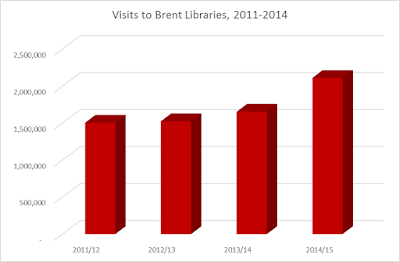
Annual visit numbers have gone up by 40% by the end of 31 March 2015, topping two million. The full table is here:
2011/12 1,506,852
2012/13 1,526,095 1.3%
2013/14 1,654,807 8.4%
2014/15 2,112,149 27.6%
Annual loan numbers for the same period are:
2011/12 985,590
2012/13 963,188 -2.3%
2013/14 996,930 3.5%
2014/15 1,021,180 2.4%
The third relevant test is the user satisfaction ratings, which are pretty good, although they have not been renewed for a while.
This performance is all the more remarkable given the general decline of library usage across the country. Brent libraries buck this trend.
Why are Brent Libraries Successful?
Many people find these numbers counter intuitive because in 2011 Brent decided to close half its libraries, and significantly reduce the overall budget. How therefore can the number of users and loans and satisfaction ratings all have increased?
My answer would be that, at least in a small urban area with good transport links, people can travel to a different library fairly easily. The second, often overlooked part of the answer, is that Brent deliberately improved the libraries that were kept open. Opening hours were extended to seven days a week. The book fund was protected (although it has now fallen back to a level just above Brent's CIFPA comparator Boroughs). Crucially, Brent also had major capital investment to improve its libraries in Kilburn, Wembley and Willesden as well as more minor changes in the other three.
This has also allowed the library service to engage more with changing social trends. Some have claimed that these trends make libraries obsolete. I think that changes in technology actually make libraries more relevant than ever, although with less of an emphasis on paper books.
Newer libraries are able to be able to be designed in a way that accommodates wireless technology more easily, as opposed to a model based on deskbound computers. Bigger libraries , such as Wembley, have more flexibility to deal with events, or with the different needs of users (such as small children who tend to be noisy as opposed to students who want quiet to study).
Why are Brent Libraries Important?
The importance of Brent libraries for other areas is that they show a model that can be made to work despite continuing cuts in funding. Granted it is a model for urban areas, and rural areas face very different problems. However, the present government has been re-elected, and looks set to continue to continue its library policy. An example like Brent, which shows that public library services do not just have to be about nothing but ongoing cuts, should be welcomed.
UPDATE
I have answered the comment below querying the role of fire drills in a separate post.
Firstly, lets look at the visit numbers since Brent passed its Libraries Transformation Project back in April 2011.

Annual visit numbers have gone up by 40% by the end of 31 March 2015, topping two million. The full table is here:
2011/12 1,506,852
2012/13 1,526,095 1.3%
2013/14 1,654,807 8.4%
2014/15 2,112,149 27.6%
Annual loan numbers for the same period are:
2011/12 985,590
2012/13 963,188 -2.3%
2013/14 996,930 3.5%
2014/15 1,021,180 2.4%
The third relevant test is the user satisfaction ratings, which are pretty good, although they have not been renewed for a while.
This performance is all the more remarkable given the general decline of library usage across the country. Brent libraries buck this trend.
Why are Brent Libraries Successful?
Many people find these numbers counter intuitive because in 2011 Brent decided to close half its libraries, and significantly reduce the overall budget. How therefore can the number of users and loans and satisfaction ratings all have increased?
My answer would be that, at least in a small urban area with good transport links, people can travel to a different library fairly easily. The second, often overlooked part of the answer, is that Brent deliberately improved the libraries that were kept open. Opening hours were extended to seven days a week. The book fund was protected (although it has now fallen back to a level just above Brent's CIFPA comparator Boroughs). Crucially, Brent also had major capital investment to improve its libraries in Kilburn, Wembley and Willesden as well as more minor changes in the other three.
This has also allowed the library service to engage more with changing social trends. Some have claimed that these trends make libraries obsolete. I think that changes in technology actually make libraries more relevant than ever, although with less of an emphasis on paper books.
Newer libraries are able to be able to be designed in a way that accommodates wireless technology more easily, as opposed to a model based on deskbound computers. Bigger libraries , such as Wembley, have more flexibility to deal with events, or with the different needs of users (such as small children who tend to be noisy as opposed to students who want quiet to study).
Why are Brent Libraries Important?
The importance of Brent libraries for other areas is that they show a model that can be made to work despite continuing cuts in funding. Granted it is a model for urban areas, and rural areas face very different problems. However, the present government has been re-elected, and looks set to continue to continue its library policy. An example like Brent, which shows that public library services do not just have to be about nothing but ongoing cuts, should be welcomed.
UPDATE
I have answered the comment below querying the role of fire drills in a separate post.
Saturday, 9 May 2015
Tricycle Theatre and Jewish Film Festival Make Up
I have been rather busy during the General Election so this blog has rather fallen into disuse. However, it is noteworthy that the Tricycle Theatre have now apologized to the Jewish Film Festival (JFF). I always thought the Tricycle had just been the victim of its own muddled thinking rather than ill intentioned so I hope their relations return to normal.
Wednesday, 8 April 2015
Greens and the SNP
Jim Murphy has made the obvious point that it makes no sense for the SNP to ask English voters to vote against Labour if they really want to see a Labour government. The public position of Nicola Sturgeon is that she thinks English voters should vote Green, but anyone who considers that for few moments knows that the effect of that suggestion is to maximise the possibility of a Tory government.
I suspect that is precisely what Nicola Sturgeon wants. Her more minor reason for the move is to sideline the Green Party in Scotland, something that the English Greens seem all too eager to help the SNP with. If I were a Scots Green I would feel utterly betrayed by my colleagues south of the border.
I suspect that is precisely what Nicola Sturgeon wants. Her more minor reason for the move is to sideline the Green Party in Scotland, something that the English Greens seem all too eager to help the SNP with. If I were a Scots Green I would feel utterly betrayed by my colleagues south of the border.
Tuesday, 7 April 2015
Shahrar Ali let off the Hook
I see that the Kilburn Times has an extremely gentle piece on Shahrar Ali. It glosses over the various ways in which the Green Party has sought to block environmental objectives, including food growing, one of Europe's greenest buildings, carbon emissions, improved recycling, and even district heating.
The strangest of these is the entrenched hostility to Brent Civic Centre. The environmental benefits of this building are huge, and unattainable realistically in any other way. People who stand for election really should expect a far higher standard of accountability than appears in the piece.
The strangest of these is the entrenched hostility to Brent Civic Centre. The environmental benefits of this building are huge, and unattainable realistically in any other way. People who stand for election really should expect a far higher standard of accountability than appears in the piece.
Monday, 6 April 2015
The Damage of Volunteer Libraries
Dawn Finch, who is an eminent figure in CILIP, the professional body for library professionals has posted a harsh critique of volunteers running community managed libraries. I wouldn't agree with every point in it but I recognise the general thrust.
One point that does not come across in the piece is the effect on a wider Council service running alongside the volunteer service. Since this appears to be the preferred model in many authorities, it is worth pointing out.
Most "stand alone" volunteer libraries actually seem to need a lot of professional support in dealing with areas that volunteers have little or no experience in. That does not just mean direct library stuff. It includes facility management, various kinds of insurance, legal matters, building maintenance, trade waste contracts and so on. There is some evidence that volunteer organisations have had unrealistic, or at least misunderstood, expectations of what they can expect. It does not appear to be understood that a key driver for many authorities are the huge weight of funding cuts hitting areas of high and rising demand for public services. I suspect that for most of the authorities that have gone down this route, volunteer libraries are simply a relatively easy way for the authority to jettison responsibility for the building concerned.
That sort of thing, in many authorities, is dealt with by departments other than the libraries department.
On specific library expertise, again many volunteers don't seem to understand how complicated it can be or what level of pressures the library staff may be under. One example is the necessity of tagging books if self service technology is going to work. Take the comments here:
"One of the important subjects discussed was the exploration of what could be shared by the Brent Library Service and Community Libraries. This is very important for us because part of our future success, I believe, will be the extent to which we are able to develop a good working relationship with the Brent library service – maybe not financial (as such), but, sharing services, contracts for outreach services, volunteers, training and being part of their lending and IT services could save us a lot of headaches (and finance) and be very significant for our operation of a community library."
There appears to be little or no understanding of how relying on various services drains financial and other resources away from Brent Council Library service, and thereby endanger the effective delivery of the Libraries Transformation Project.
In other words, having volunteer libraries can actively damage a traditional Council library service rather than adding to it.
One point that does not come across in the piece is the effect on a wider Council service running alongside the volunteer service. Since this appears to be the preferred model in many authorities, it is worth pointing out.
Most "stand alone" volunteer libraries actually seem to need a lot of professional support in dealing with areas that volunteers have little or no experience in. That does not just mean direct library stuff. It includes facility management, various kinds of insurance, legal matters, building maintenance, trade waste contracts and so on. There is some evidence that volunteer organisations have had unrealistic, or at least misunderstood, expectations of what they can expect. It does not appear to be understood that a key driver for many authorities are the huge weight of funding cuts hitting areas of high and rising demand for public services. I suspect that for most of the authorities that have gone down this route, volunteer libraries are simply a relatively easy way for the authority to jettison responsibility for the building concerned.
That sort of thing, in many authorities, is dealt with by departments other than the libraries department.
On specific library expertise, again many volunteers don't seem to understand how complicated it can be or what level of pressures the library staff may be under. One example is the necessity of tagging books if self service technology is going to work. Take the comments here:
"One of the important subjects discussed was the exploration of what could be shared by the Brent Library Service and Community Libraries. This is very important for us because part of our future success, I believe, will be the extent to which we are able to develop a good working relationship with the Brent library service – maybe not financial (as such), but, sharing services, contracts for outreach services, volunteers, training and being part of their lending and IT services could save us a lot of headaches (and finance) and be very significant for our operation of a community library."
There appears to be little or no understanding of how relying on various services drains financial and other resources away from Brent Council Library service, and thereby endanger the effective delivery of the Libraries Transformation Project.
In other words, having volunteer libraries can actively damage a traditional Council library service rather than adding to it.
Sunday, 5 April 2015
Traffic Enforcement in Harlesden Town Centre
Since the new Harlesden Town Centre Scheme started operating, I have noticed that numerous cars still go down the street in front of Harlesden Methodist Church, where they are prohibited. Brent Council really needs to enforce its traffic restrictions if the scheme is going to work as it is supposed to.
Saturday, 4 April 2015
SNP Backs David Cameron
I was startled to read the Daily Telegraph scoop this morning. According to a leaked memo, Nicola Sturgeon is secretly rooting for David Cameron to remain as Prime Minister. While, the SNP preference for the Tories over Labour is obvious to people who actually follow their strategy, it will come as a big shock to some "progressive" people South of the Border.
The memo is written by a UK Civil Servant based on what French diplomatic sources told him/her of conversations between Nicola Sturgeon and French diplomats. It is apparently standard protocol for such reports to be passed to the UK government. It is not standard practice for such documents to be leaked to the newspapers, and Nicola Sturgeon is now denying the remarks were made, as (rather more weakly) are the French diplomats.
Cato the Elder had a good rule of thumb for such enquiries, which was to ask: Who Benefits?
The SNP categorical denials don't convince me since it seems very obvious that they want to stop Labour forming a government. Why else ask people in England to vote Green, and Welsh voters to go for the Welsh Nats. They also have a long record of denials that turn out to be false statements on legal advice to the EU, the Oil price, the currency and so on. They have used up what credibility they have.
I imagine the French diplomats are hugely embarrassed to be dragged into an election campaign in their host country, but they had no reason to misinform the UK Civil Service, or to assume the communication would be leaked. They do now have good reason to try to distance themselves from the whole thing, as it is career threatening for any diplomat to be anywhere near this.
I can't see why the UK Civil Servant who wrote the memo should have wanted to include misinformation. I imagine s/he is cringing under a desk at the moment wondering what is going to happen.
In terms of who leaked it. I don't see it as being either the SNP or the Tories since their effective alliance cannot be openly acknowledged by its very nature. It can't be Labour, because how would they get it? If I were heading the Leak Enquiry, I would be visiting the Liberal Democrat SoS for Scotland office, as it seems most likely to help the Liberal Democrats.
The memo is written by a UK Civil Servant based on what French diplomatic sources told him/her of conversations between Nicola Sturgeon and French diplomats. It is apparently standard protocol for such reports to be passed to the UK government. It is not standard practice for such documents to be leaked to the newspapers, and Nicola Sturgeon is now denying the remarks were made, as (rather more weakly) are the French diplomats.
Cato the Elder had a good rule of thumb for such enquiries, which was to ask: Who Benefits?
The SNP categorical denials don't convince me since it seems very obvious that they want to stop Labour forming a government. Why else ask people in England to vote Green, and Welsh voters to go for the Welsh Nats. They also have a long record of denials that turn out to be false statements on legal advice to the EU, the Oil price, the currency and so on. They have used up what credibility they have.
I imagine the French diplomats are hugely embarrassed to be dragged into an election campaign in their host country, but they had no reason to misinform the UK Civil Service, or to assume the communication would be leaked. They do now have good reason to try to distance themselves from the whole thing, as it is career threatening for any diplomat to be anywhere near this.
I can't see why the UK Civil Servant who wrote the memo should have wanted to include misinformation. I imagine s/he is cringing under a desk at the moment wondering what is going to happen.
In terms of who leaked it. I don't see it as being either the SNP or the Tories since their effective alliance cannot be openly acknowledged by its very nature. It can't be Labour, because how would they get it? If I were heading the Leak Enquiry, I would be visiting the Liberal Democrat SoS for Scotland office, as it seems most likely to help the Liberal Democrats.
Wednesday, 1 April 2015
Ibrahim Taguri Not Standing
I gather Ibrahim Taguri is not standing after all, so it will be up to Lauren Keith to lose for the Liberal Democrats in Brent Central.